Site Highlight: Beaconsfield Canyon
- Friends of Sausal Creek
- Feb 12
- 5 min read
Updated: Feb 16
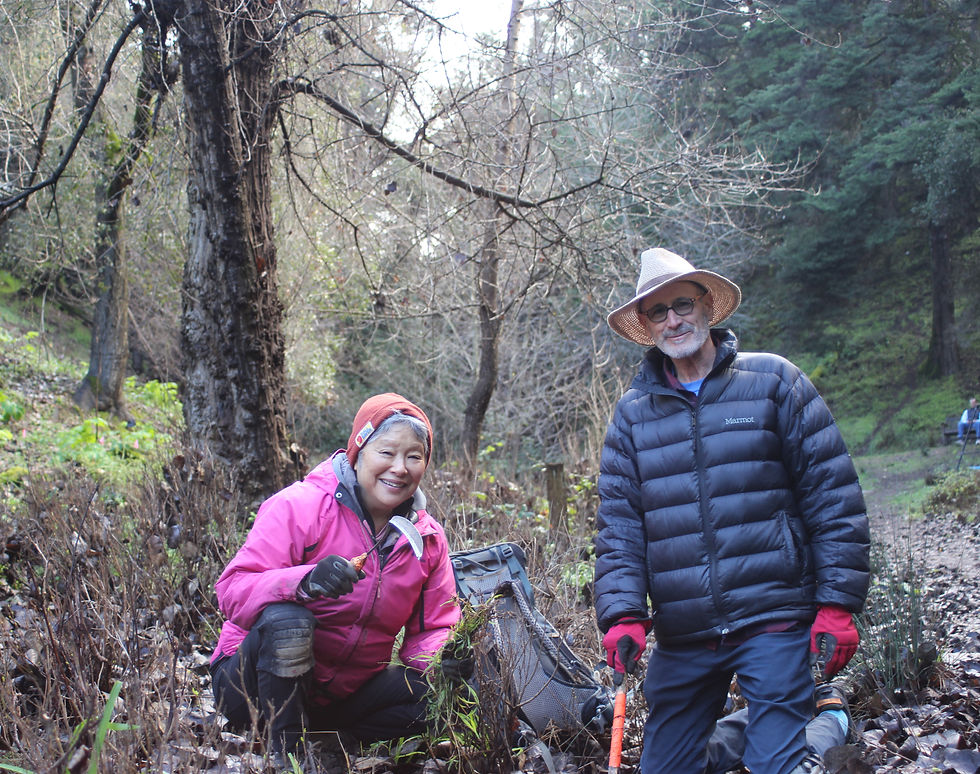
In 2007, Wendy Tokuda and Richard Kauffman organized the first work party at Beaconsfield Canyon, and have been leading restoration efforts at the site ever since. Once slated for development, this 5.5 acre city-owned open space in upper Montclair harbors four different habitats and a wealth of native plants, including a stand of locally rare black cottonwood trees. Volunteers meet the last Saturday of most months, 9 a.m. -12 p.m., and are hoping to welcome new community members to the group.
Following up on this great article written by Richard in 2022 about how they got started, our site leaders shared how the canyon has transformed over the years, their connection to the space, and what this work means to them. Check the events calendar for upcoming workdays at Beaconsfield.

FOSC: Nearly two decades into monthly workdays, what feels most different about Beaconsfield today compared to when you first looked over the fence? What do you hope the next 20 years will bring?
Wendy: It used to be kind of creepy- dark and overgrown with weeds. There was a broken computer and other garbage at the end of the trail. Someone had set up a few folding chairs there, and tiki torches where I assume they would gather at night. It was even more of a fire waiting to happen than Richard could see below his fence. We hauled out tires, wine bottles, and our best prize- an old washing machine.
Now, it’s a little nature preserve, where families come, where people walk their dogs and moms bring their babies. It’s our green oasis.
I hope more people come to the canyon to volunteer and enjoy its beauty. These green spaces will become more and more important, as we keep building and paving, and as the planet keeps warming.
Climate change makes us feel so helpless, but volunteering to restore habitat is the perfect antidote. It’s something we can all do right in our own backyard. Plus it’s good for your mind and soul!
Richard: I think the most noticeable difference today is not the quantity of vegetation (it’s always very green) but the density. The hillsides are no longer impenetrable, they’re inviting. And if you know your plants, you’ll see far more natives than there were. My fondest hope for the future is new faces who can take over from Wendy and me.

FOSC: What are some of the particular challenges at this site?
Richard: Very steep hillsides that can be difficult to navigate. We created trails to give volunteers access, but they erode significantly every year. An infestation of ailanthus (Chinese Tree of Heaven) that’s nearly impossible to get rid of and will take over if not controlled. And, like everywhere, having enough volunteers to keep the invasives at bay.
Wendy: [Also…] poison hemlock, euphorbia sap in the eyes, and the annual yellow jacket nests you accidently disrupt.
FOSC: What moments renew your sense of energy or commitment to this site?
Wendy: I think both Richard and I have a sense of ownership and responsibility that starts in the soil in Beaconsfield, travels through our hands and into our soul. It's that deep. There’s this trance that comes over me when I’m pulling weeds or pruning, where I’m just at one with it. It’s the only time my mind is calm (even though I’m listening to political podcasts). I think that feeling of peace renews me every time I volunteer.
Richard’s sense of humor is the other thing that keeps me committed. On those few occasions when only he and I show up, I call it the Wendy and Richard Show. He always has some funny take, or bad pun to crack me up. I always tell him I’m his best audience.
These relationships are important. Now, we have an intern named Tyler Dare who I work with every Saturday. It is such a joy watching him learn and get excited about the California poppies. Plus, he’s cleared a ton of fuel load, pruning down overgrown Holodiscus and coyote bush.
Richard: Reflecting at the end of a workday on what we accomplished; watching a family of deer graze on the hillside; being there when the cottonwoods release their white, fluffy seed pods and it “snows."
FOSC: What have been some successes or moments you’ve celebrated?
Wendy: When Connie Koslowski eliminated almost all the Italian thistle; when two neighbors began to really take the fire danger seriously and significantly reduced the fuel load, clearing dead wood and limbing up trees, removing large amounts of fuel load; getting buy-in from homeowners on the rim of the canyon, who then clear the grasses and weeds in their yards before they spread seed downhill; every time an Eagle scout takes on a project to build steps or reinforce an eroding hill. Seeing the overall growth of the native plants restore the canyon is a daily thrill.
FOSC: Are there particular species that feel like indicators of the canyon’s health today?
Wendy: The sword ferns and trillium. The cow parsnip went crazy after we started pulling invasives and now we have to chop some down as it crowds other plants and the trails. I treasure any Mellica grass or wood mint that colonizes and helps prevent erosion.
The canyon is alive with birdsong. There is a resident red-winged hawk (or two?) that calls loudly as it circles above. In the winter evenings, I hear two great hornedowls hooting to each other. I believe they nest in the canyon now.
FOSC: How does caring for this place weave into the rest of your life?
Wendy: Working in Beaconsfield is how I get my exercise. It connects me to the earth and keeps me sane. It gives my life purpose and joy.
Richard: What I’ve learned about plants and horticulture from Wendy, Beth Keer and other FOSC members I’ve been able to transfer into other volunteer work that I do that’s also very satisfying. Because of the early work we did, a teacher at Joaquin Miller Elementary was able to get a grant for a series of field trips into the canyon, which both my kids participated in (as did I). This tied Beaconsfield into the community in a deeper way than before and got us more recognition with the city (then mayor Lilbby Schaaf also had kids at the school). Most of all, there's a sense of ownership, of connection to Oakland and the local ecology on the part of my whole family. Since I live on the canyon rim, I look out over the canyon from our deck every day and watch the light change, the seasons change, the hawks circle. Because of my (and Wendy’s and others’) investment of time, money and sweat all these years, I can take some satisfaction from the canyon’s preservation and improvement that allows others to enjoy it as well.
Check out this video about Beaconsfield featuring Wendy and Richard from 2012, created for the Oakland Museum of California's renovated Gallery of California Natural Sciences.


