Arts in the Watershed: Simone Lassar

Simone Lassar (she/her) is an Oakland based visual artist and educator exploring cycles through a variety of mediums including printmaking, papermaking, and natural pigments. Raised by biologist parents and the Massachusetts mud, a curiosity and connection to the Earth has flowed through her body as long as it has existed. She received a BS from MIT in Environmental Engineering with a minor in design. For the past 2.5 years, she worked as a fish biologist/research engineer for Natel Energy, a company that designs hydropower turbines that provide safe fish passage, until leaving engineering to pursue art and teaching full time. Simone’s art reflects many themes of her scientific work: plants, cycles, fish, but is infused with a little more play, magic, and community than science allows. Simone works as a teaching artist with various Bay Area orgs (SFArtsEd, Bay Area Discovery Museum, MarinMOCA) and as a freelance printmaker/illustrator.
FOSC: Can you tell us a little about your art practice and the mediums, and themes, you like to explore?
Simone: I most often work in the mediums of printmaking, papermaking, natural pigments, and illustration but I get very excited about new mediums easily, and that sometimes means I’m working in mediums like ceramics, papercut, or bookbinding! The thread through all of my work is connection to place and my immediate world. I think a lot about cycles in my work; both thematically (migration, natural cycles, seasons, environmental change), and materially (transforming found/discarded materials into paper/pigments/objects). I love creating with the prompt of using materials in abundance around me and those pulled from the waste stream. I recently have been exploring making paper from invasive plants (like French broom), and I make watercolor paints from rocks, clays, and plants gathered locally.
I have so much curiosity and reverence for the messy entanglement that we call ecology; all the hidden relationships that exist between creatures, plants, rocks, minerals, etc. For me, art (like science) is just one tool to pull at these entanglements and see where they lead.

FOSC: What is your connection to the Sausal Creek watershed, and how does that show up in your work?
Simone: I live in this watershed and I am so grateful for the creek. One of my favorite parts of working on this project was all the time I got to spend at Sausal Creek Preserve. I kept returning as I was designing the sign. I took friends there, sat and read by the water, reacquainted myself with what plants are growing there, and tried to imagine what creatures have called this place home. There was one day that I spent a few hours sitting and reading a book by the creek (Tending the Wild by M. Kat Anderson, which truly I cannot recommend enough) and chatted to a neighbor who also loves to spend time with the creek. I’ve found that the more time I spend by the creek, the more people I meet who love and care for this watershed. Sausal Creek feels very magical to me in that way, the creek nurtures us and we want to nurture it right back. That sense of mutual care is something I wanted the sign to have and serve as a reminder that this place is already loved, and worth knowing more deeply.
FOSC: Can you share about your process for designing the Sausal Creek Preserve sign?
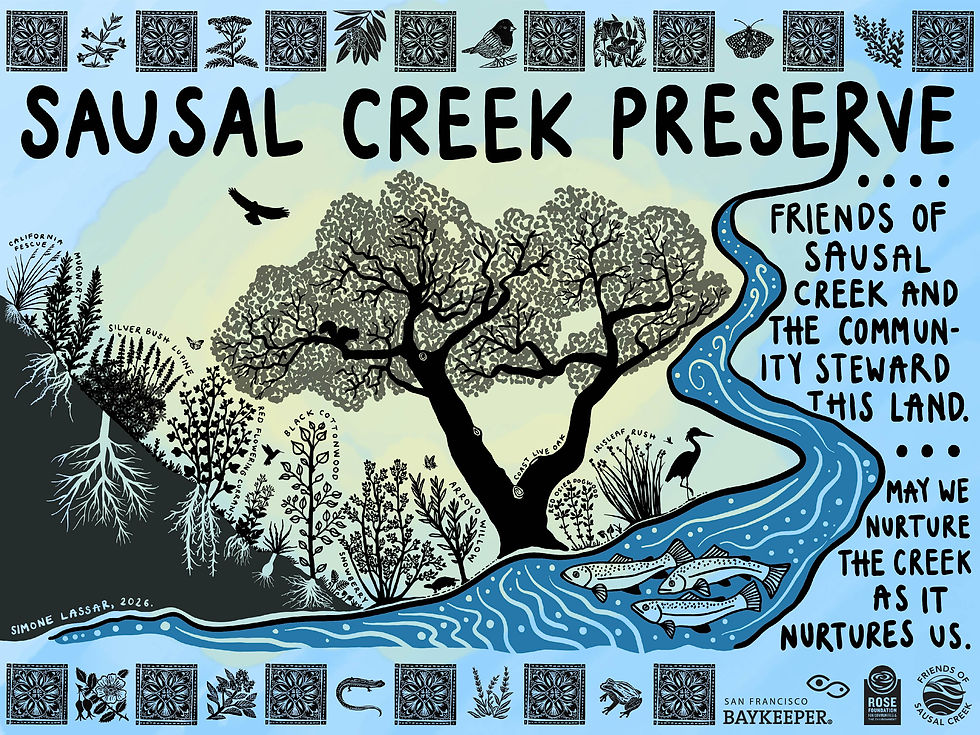
Simone: Working on this project was really exciting because of how community based it was. FOSC, and specifically Elena, did a great job of including the community in the design process at every step, and I was excited to get to work with a group of people (dubbed the signage committee) who cared so much about their local restoration site. At our first meeting, I asked participants to think about what they would like to see represented on the sign, organized around three categories: the personal, the ecological, and the cultural. A few themes emerged repeatedly: humans as active participants in the site, the somatic experience of being near a creek, showcasing the creek's ecology, and the cultural significance of Fruitvale to this site. I started the design thinking about how I could visually represent these themes.
The entire process with the signage committee was collaborative and iterative. I started designing with these themes in mind and came up with two rough sketches of sign layout. I got feedback from the signage committee on which design they preferred, and then refined that design further. I got more feedback on the refined design and finally found a path towards the final design. There was one meeting where we printed out the in-progress design on 3’x4’ paper to get a sense of how the sign would actually look at full scale. This was helpful for seeing the scale at which details appear on the sign, and where I could add complexity versus where I needed to pare down. I find digital design really satisfying because I have flexibility to try a lot of different things and choose which path works the best.
From the beginning, I wanted to incorporate linoleum printed features alongside the digital illustrations on the sign. I love the tactile aesthetic of linoleum prints, and I like that their handmade feel connects to the many hands who have contributed to making this site what it is. The top and bottom border of the sign is made up of individual linoleum prints that I carved, printed, and then scanned, which feature plants and animals of the Sausal Creek watershed. The tile in between each plant/animal carving is based on a floor tile I saw at a taqueria in Fruitvale, as a nod to the culture and art of Fruitvale. It was also important that the plant and animal life depicted in the sign was accurate to the ecology of the site. I was lucky to be able to collaborate with plant lovers and experts on the signage committee, including Noé and Kristy, who gave valuable feedback about what plants and animals are native to the watershed.
I have a few favorite details. I love the ‘R’ in ‘PRESERVE’ flowing into the creek. I like the words on the right-hand side, the signage committee put a lot of care into deciding what exactly we wanted to say about this site. The coast live oak on the sign is based on one of the actual trees at the restoration site, and I imagine that at some point a squirrel has probably sat exactly in that spot on the tree. And I of course love the lino printed tiles, my favorites are probably the dark-eyed junco (top row, 4th from the left), hummingbird sage (bottom row, 4th from the left), and the pacific chorus frog (bottom row, 5th from the left).